Splash Pads vs. Pools: Which is Better for Young Kids?
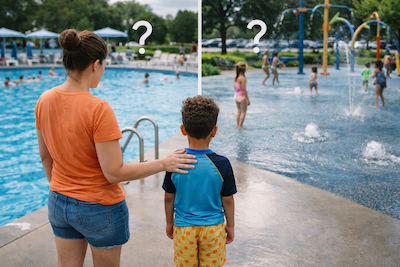
It's a question that comes up every summer in parenting groups, neighborhood forums, and family text threads: should we take the kids to the splash pad or the pool?
The honest answer is that both are great — but they serve different purposes, work better for different ages, and come with different trade-offs. A splash pad visit and a pool visit are fundamentally different experiences, and understanding those differences helps you choose the right one for your family on any given day.
Here's an honest comparison.
Safety
This is the factor most parents care about first, and it's where the biggest difference lies.
Splash Pads
Modern splash pads are designed with zero-depth water play — water sprays up from ground-level features and drains immediately. There is no standing water. This eliminates the drowning risk that is inherent in any body of standing water.
That doesn't mean splash pads are risk-free. Children can slip on wet surfaces, trip over features, or collide with other kids running through the spray. But these are scrapes-and-bruises risks, not life-threatening ones.
Most community splash pads do not require lifeguards because there's no standing water to guard. This means they can operate longer hours with lower staffing costs — but it also means parent supervision is the only supervision.
Pools
Swimming pools involve standing water, which means drowning is a real and present risk. The CDC reports that drowning is the leading cause of death for children ages 1-4, and the second leading cause for ages 5-14. Pools with lifeguards mitigate this risk significantly, but the risk never reaches zero as long as standing water is present.
Pools also require that children either know how to swim or wear flotation devices, which adds a layer of preparation and equipment that splash pads don't require.
Verdict
For children under 4 who can't swim: Splash pads are significantly safer. The zero-depth design eliminates the drowning risk entirely.
For children who can swim: Pools are safe with proper supervision and lifeguards, and they offer a more complete aquatic experience.
Cost
Splash Pads
The majority of community splash pads are free. They're operated by city parks departments and funded by municipal budgets. You walk up, play, and leave. No admission, no membership, no locker rental.
Even paid splash pads at water parks and resorts are typically less expensive than pool admission because they don't require lifeguard staffing.
Pools
Community pools typically charge daily admission ($3-$10 per person) or require a seasonal membership ($50-$200+ per family). Private pool memberships can run $500-$2,000+ per summer. Add in swim lessons, which most families consider a necessary investment, and the cost profile is significantly higher.
Verdict
Splash pads win on cost — often by a wide margin. Free vs. paid is a meaningful difference for families who want to visit multiple times per week throughout the summer.
Age Appropriateness
Splash Pads
Splash pads shine for the under-5 crowd. Toddlers who can barely walk can toddle through a gentle bubbler. Two-year-olds can stomp in puddles. Three-year-olds can chase each other through spray jets. No swimming ability is required. No flotation devices needed. No depth to navigate.
For older kids (8+), splash pads can start to feel "too young" — the features are designed primarily for younger children, and there's less challenge than a pool with diving boards, lap lanes, and deep water.
Pools
Pools come into their own for school-age kids and up. Once children can swim, a pool offers experiences a splash pad can't — diving, underwater play, lap swimming, water games with depth, and the physical challenge of swimming itself.
For toddlers and non-swimmers, pools are more stressful (for both kids and parents) because constant vigilance around standing water is required.
Verdict
Under 5: Splash pads. The zero-depth design is purpose-built for this age group.
Over 7: Pools. Older kids want depth, diving, and the challenge of swimming.
5-7: Both work. This is the transition age where kids can enjoy splash pads and are starting to develop swimming skills for pools.
Supervision Requirements
Splash Pads
You need to watch your kids, but the stakes are lower. There's no standing water to guard against, so the supervision is more about preventing collisions and making sure they don't wander out of the splash pad area. Many parents sit on a nearby bench within eyesight — something that's generally not appropriate at a pool.
Pools
Pool supervision must be active, constant, and close. The American Academy of Pediatrics recommends "touch supervision" for children under 5 at pools — meaning a parent should be within arm's reach at all times. Even with lifeguards present, parents are the primary line of defense against drowning.
This is exhausting. An hour of pool supervision for a toddler parent is significantly more tiring than an hour of splash pad supervision.
Verdict
Splash pads are less demanding on parents. This matters — especially for parents with multiple children of different ages, or for parents who are solo-supervising.
Developmental Value
Splash Pads
Splash pads provide excellent motor development opportunities — running on wet surfaces, dodging sprayers, pouring and scooping water, and navigating unpredictable spray patterns all build balance, coordination, and spatial awareness. The sensory input from water play (temperature, pressure, texture) supports sensory processing development in young children.
Pools
Pools offer everything splash pads do plus the unique developmental benefits of actual swimming — bilateral coordination, breath control, buoyancy awareness, and the physical confidence that comes from learning a lifesaving skill. Swimming is one of the most complete physical activities available to children.
Verdict
Both are valuable. Splash pads excel at motor development for the youngest children. Pools add swimming-specific skills that splash pads can't provide. They're complementary, not competing.
Convenience
Splash Pads
Walk up, play, leave. No changing rooms required (though they're nice to have). No shower before entering. No swimming test. No wristbands. Many families visit splash pads in regular clothes — just strip down to a swimsuit or even play in shorts and a t-shirt.
Pools
Pools involve more logistics: swimsuit required, shower before entry (at many facilities), possible swim test for unaccompanied children, locker rental, admission payment, and the full towel-dry-change routine afterward.
Verdict
Splash pads win on convenience. The low barrier to entry is one of the main reasons families visit splash pads more frequently than pools — a splash pad visit can be spontaneous. A pool visit usually requires planning.
Social Experience
Splash Pads
Splash pads tend to be more communal and unstructured. Kids of all ages share the same space, create their own games, and interact freely. There's no lane assignment, no shallow-end/deep-end division, and no structured activity. This makes splash pads excellent for social play — kids naturally team up, chase each other, and play together.
Pools
Pools offer a more structured social experience — swim teams, water polo, diving groups, and swim lessons create built-in social circles. For school-age children, pools become social hubs in a way that splash pads typically don't.
Verdict
Splash pads for unstructured social play. Pools for structured social activities. Both are valuable at different ages.
The Bottom Line: They're Complementary, Not Competing
The best answer to "splash pad or pool?" is: both, at different times and for different reasons.
Choose a splash pad when:
- Your children are under 5
- You want a free, spontaneous outing
- You're looking for low-stress supervision
- Swimming skills aren't developed yet
- You want sensory-rich play without drowning risk
Choose a pool when:
- Your children can swim (or are learning)
- You want structured water activities (lessons, teams)
- Older kids want depth and diving
- You're willing to invest the time and cost for a more complete aquatic experience
Use both when:
- You have children of mixed ages (toddler + school-age)
- You want variety across the summer
- You're building water comfort before starting swim lessons
Splash pads are where water play begins. Pools are where it deepens. Both deserve a place in your family's summer.