Splash Pad Etiquette: The Do's and Don'ts Every Family Should Know
Splash pads don't come with a rule book. There's no orientation video, no employee handing you a laminated list, and no lifeguard explaining the code of conduct. You just show up, and somehow everyone is expected to know how this works.
Most families figure it out. But every splash pad regular has stories: the parent on their phone while their kid tackles strangers, the family that claimed half the shade with a camping setup, the teenager who brought a Super Soaker to a toddler splash pad.
These aren't crimes. They're just the result of unwritten rules that nobody ever writes down.
Until now.
The Do's
Do: Supervise Your Children
This is the big one. Splash pads don't have lifeguards (most of them, anyway). The zero-depth design eliminates drowning risk from standing water, but it doesn't eliminate the need for a parent who's paying attention.
Kids slip on wet surfaces. They collide at full speed. Toddlers wander toward parking lots. Older kids play rough without realizing a two-year-old is right behind them.
You don't need to hover — but you need to be present, watching, and close enough to intervene. That means eyes off the phone for the duration of the visit. Yes, the whole visit.
Do: Apply Sunscreen Before You Arrive
Apply sunscreen at home, 15-20 minutes before water exposure. Doing it at the splash pad means your kid is already running toward the water before the SPF has set, and you're chasing them with a tube of Coppertone.
Reapply every 90 minutes if you're staying longer. Water play washes sunscreen off faster than dry play.
Do: Use Swim Diapers
Regular diapers absorb water, swell to three times their size, and eventually fail. This is not theoretical — it happens at every splash pad, and it's exactly as unpleasant as it sounds.
If your child is in diapers, use a swim diaper. Reusable swim diapers are more comfortable, more reliable, and more cost-effective than disposable ones for families who visit regularly.
Do: Bring Your Own Towels and Supplies
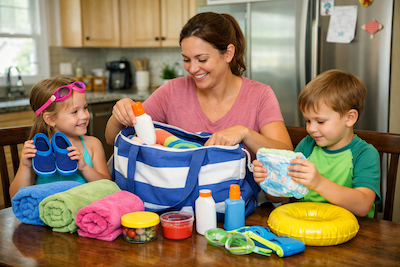
Splash pads don't provide towels, sunscreen, or shade. Come prepared with:
- Towels (at least one per child, plus a spare)
- Sunscreen
- Water bottles
- Snacks in sealed containers
- A change of dry clothes
Expecting to borrow from other families or finding supplies at the splash pad is a recipe for a short, uncomfortable visit.
Do: Share the Space
Splash pads are shared public spaces. Your family doesn't own the shady bench, the favorite spray feature, or the section of splash pad closest to the parking lot.
If a feature is popular, take turns. If a toddler is playing quietly at a bubbler, don't send your 8-year-old sprinting through the same space. If you're setting up a shade tent, leave room for other families to find shade too.
Do: Clean Up When You Leave
Take everything you brought — towels, food wrappers, water bottles, toys, swim diapers. Splash pads don't have cleaning crews between visits. The family after you is stepping into whatever you leave behind.
Do: Respect the Facility Rules
Some splash pads post rules: no food in the spray area, no glass containers, no running on certain surfaces, dogs not allowed. These rules exist for safety and maintenance reasons. Follow them, even if you think they're unnecessary. The parks department that built the splash pad knows its facility better than you do.
Do: Thank the Parks Department
If your community has a well-maintained free splash pad, that's not an accident — it's a budget decision that someone fought for. A quick "thank you" email to your city's parks and recreation department goes further than you'd think. These programs survive on community support, and hearing from happy families helps justify the budget to city council.
The Don'ts
Don't: Bring a Super Soaker to a Toddler Splash Pad
Small water squirters are fine. But high-powered water guns that shoot pressurized streams across 30 feet have no place at a splash pad shared with babies and toddlers. A Super Soaker blast to the face of a two-year-old will ruin their day (and probably yours, when their parent comes over to discuss it).
Read the room. If the splash pad is full of little kids, save the water artillery for the backyard.
Don't: Let Your Kids Monopolize Features
The dumping bucket is exciting. The water cannon is fun. But if your child has been occupying the same feature for 20 minutes while other kids wait, it's time to encourage them to rotate. Splash pads work best when everyone shares the features and moves through the space.
Don't: Change Diapers at the Splash Pad
Use the restroom. If there's no restroom, use your car. Changing a diaper on the splash pad surface, on a bench next to the spray area, or on a towel near other families is a hygiene issue. Splash pad water is recirculated through filtration systems, but that system isn't designed to handle what happens during a diaper change.
Don't: Bring Glass
Glass water bottles, glass food containers, glass anything — leave it in the car. Splash pad surfaces are hard (concrete, rubber, tile), and everyone is barefoot. One dropped glass container creates a safety hazard that can affect dozens of families and potentially close the facility for the day.
Bring plastic or stainless steel only.
Don't: Let Sand Into the System
If you're coming from a playground with sand, rinse your kids' feet and toys before entering the splash pad area. Sand clogs the filtration and drainage systems that keep splash pad water clean. It's one of the most common causes of maintenance shutdowns.
Don't: Bring Sick Kids
If your child has diarrhea, a stomach virus, or an active skin infection, skip the splash pad until they've been symptom-free for at least 24 hours. Splash pad water is treated, but recirculating systems work best when they're not being actively challenged by illness.
This isn't about being precious — it's about keeping a shared water source safe for the babies and immunocompromised children who use the same facility.
Don't: Set Up Camp in the Splash Zone
Your shade tent, cooler, towels, and beach chairs belong on the perimeter, not in or immediately adjacent to the spray features. The splash pad itself is for playing, not for sitting. When a family sets up camp in the middle of the spray area, they're effectively claiming public space and creating obstacles that running children have to dodge.
Don't: Leave Swim Diapers in the Splash Pad
Used swim diapers go in the trash — the actual trash can, not on the ground, not in a bush, and absolutely not left on the splash pad surface. This happens more often than it should, and it's exactly as gross as you're imagining.
A Note About Different Parenting Styles
Not every family approaches splash pads the same way, and that's fine. Some parents sit back and let their kids figure things out independently. Others stay within arm's reach at all times. Some families bring elaborate setups with chairs, tents, and coolers. Others show up with just towels and sunscreen.
None of these approaches is wrong — as long as the basics are covered: supervise your kids, share the space, clean up after yourself, and be aware of how your family's behavior affects other families.
Splash pads work because they're informal, unstructured, and self-governing. A little courtesy goes a long way toward keeping them that way.