The History of Splash Pads in America: From Fire Hydrants to Interactive Spray Parks
Every summer, millions of American kids run through ground-level water jets, dodge timed sprayers, and shriek their way across interactive spray parks in communities from coast to coast. Splash pads are so common now that it's easy to forget they haven't always been here.
The truth is, the modern splash pad is the result of over a century of evolution — from the most basic forms of urban water play to the engineered, recirculating spray parks that cities invest millions in today. It's a story about public health, urban planning, child safety, municipal budgets, and the simple, persistent human desire to cool off in the summer.
The Beginning: Fire Hydrants and Street Play (Early 1900s)
The oldest form of public splash play in America wasn't designed at all. It was improvised.
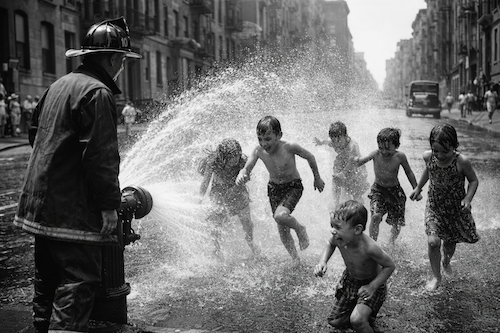
In the early 20th century, children in dense urban neighborhoods — particularly in New York, Chicago, and Philadelphia — opened fire hydrants during heat waves to create makeshift water play in the streets. The practice was technically illegal (it reduced water pressure for firefighting), but it was so widespread and so necessary that cities couldn't stop it.
By the 1930s, some cities began installing spray caps on hydrants — metal attachments that reduced the flow from a full-pressure blast to a gentler fan-shaped spray. New York City eventually formalized the practice, allowing residents to request spray caps from the fire department during summer months. The spray cap program still exists today.
This was the first acknowledgment by city governments that public water play wasn't just mischief — it was a genuine community need.
Wading Pools and Concrete Play Areas (1920s–1960s)
As cities grew and urban planning became more formalized, parks departments began building dedicated water play facilities. The earliest versions were simple concrete wading pools — shallow basins filled with standing water, typically 6-12 inches deep.
Wading pools appeared in city parks across the country from the 1920s through the 1960s. They were inexpensive to build, required no mechanical systems beyond a water supply and a drain, and gave children a safe place to cool off under the watch of parents and recreation staff.
But wading pools had problems:
- Hygiene: Standing water with dozens of children created sanitation concerns. Diaper-age children, in particular, introduced bacteria into shared water that didn't circulate or filter.
- Drowning risk: Even shallow standing water posed a drowning hazard for very young children. Incidents were rare but real.
- Maintenance: Concrete pools cracked, drains clogged, and the daily fill-and-drain cycle consumed significant water.
By the 1970s and 1980s, many cities had begun questioning whether wading pools were the best approach to public water play. The search for something better had begun.
The Spray Shower Era (1970s–1990s)
The next evolution came in the form of spray showers and spray decks — above-ground spray features that eliminated standing water entirely.
New York City was a pioneer here. The Parks Department began installing spray showers in playgrounds across the five boroughs, eventually building one of the largest networks of public spray features in the world. Other cities followed: Chicago, Philadelphia, Los Angeles, and dozens of smaller municipalities added spray features to their parks.
The key innovation was the concept of zero-depth water play. By eliminating standing water and using only spray features that drained immediately, cities solved the two biggest problems of wading pools:
- No drowning risk from standing water
- Better hygiene because water didn't pool and stagnate
Early spray features were simple — often just a few vertical pipes with spray heads attached to a concrete pad with a central drain. They weren't interactive or programmable. They just sprayed. But they worked, and they were dramatically safer than wading pools.
The Modern Splash Pad Emerges (1990s–2000s)
The term "splash pad" entered common use in the 1990s as water play technology advanced significantly. Several developments converged:
Recirculating Water Systems
Early spray features used potable water on a flow-through basis — clean water in, drain to waste. This was expensive and wasteful. In the 1990s, manufacturers developed recirculating systems that filtered, treated, and reused water, dramatically reducing water consumption and operating costs. This made larger, more elaborate spray parks economically feasible for municipal budgets.
Interactive and Programmable Features
Water play equipment manufacturers began developing features that went far beyond simple spray heads. Ground-level jets that activated on timers or motion sensors, dumping buckets, water cannons, misting arches, and themed spray sculptures all appeared during this period. The splash pad evolved from a wet concrete slab into an interactive play environment.
Safety Standards
The industry developed voluntary safety standards for splash pad design, including non-slip surfaces, water quality guidelines, and accessibility requirements. Organizations like the Association of Pool and Spa Professionals (APSP) published guidelines that helped municipalities design safer facilities.
The ADA Factor
The Americans with Disabilities Act (1990) influenced splash pad design by requiring accessible public recreation facilities. Zero-depth splash pads, with their flat ground-level surfaces and no barriers to entry, became a model for inclusive water play. A child in a wheelchair could roll directly into a splash pad's spray zone — something impossible with a traditional pool or wading area.
The Boom: Splash Pads Go Mainstream (2000s–2010s)
The 2000s saw an explosion of splash pad construction across the United States. Several factors drove the boom:
Cost Advantage Over Pools
A community splash pad costs a fraction of what a swimming pool costs to build and operate. No lifeguards are required for zero-depth facilities (in most jurisdictions), insurance costs are lower, and maintenance is simpler. For cash-strapped municipal budgets, a splash pad delivered more recreational value per dollar than any alternative.
Liability Reduction
Swimming pools carry significant liability exposure — drowning incidents, slip-and-fall injuries, diving accidents. Splash pads, with no standing water and ground-level features, dramatically reduced the liability profile. Risk managers and city attorneys favored them for this reason alone.
Parent Demand
As millennial parents entered the family-formation years, demand for safe, accessible, outdoor play spaces grew. Splash pads fit perfectly: they were free (or cheap), required no swimming ability, welcomed all ages from babies to grandparents, and provided the unstructured outdoor play that pediatricians and child development experts were recommending.
The Inclusive Play Movement
The broader movement toward inclusive playground design embraced splash pads as a model. Zero-depth, barrier-free, sensory-rich, and welcoming to children of all abilities — splash pads checked every box on the inclusive design checklist.
Where We Are Today (2020s)
The modern American splash pad is a sophisticated piece of recreation infrastructure. Today's facilities feature:
- Dozens of interactive features — ground jets, timed sprayers, motion-activated streams, misting arches, dumping buckets, and water tables
- Recirculating and UV-treated water systems that conserve water and maintain quality
- Themed designs that transform a concrete pad into a pirate ship, a rainforest, or a beach scene
- Accessible, inclusive design built to ADA standards from the ground up
- Smart controls that allow parks departments to adjust water pressure, timing, and feature activation remotely
The industry has matured to the point where specialized manufacturers (Vortex, Waterplay, Rain Deck, and others) design and install splash pads as turnkey projects for municipalities, HOAs, hotels, and private developers.
The numbers tell the story: There are now thousands of splash pads across all 50 states. SplashPadLocator.com alone lists over 3,000 facilities nationwide, and new ones are being built every year as communities continue to invest in this proven form of public recreation.
Why Splash Pads Won
The splash pad succeeded where other public water play options struggled because it solved multiple problems simultaneously:
| Challenge | Pool Solution | Splash Pad Solution |
|---|---|---|
| Drowning risk | Lifeguards required | Zero standing water — no drowning risk |
| Cost to build | $1M–$5M+ | $100K–$500K typical |
| Annual operating cost | $100K–$300K+ (staff, chemicals, insurance) | $10K–$50K (no staff, lower insurance) |
| Accessibility | Stairs, ladders, depth changes | Flat, ground-level, wheelchair accessible |
| Age range | Swimming ability required | All ages, no ability required |
| Season length | Lifeguard availability limits hours | Can operate dawn to dusk, unmanned |
The math was overwhelming. For a fraction of the cost, a community could provide water play that was safer, more inclusive, less expensive to operate, and available to more people for more hours of the day.
The Future
Splash pads continue to evolve. Current trends include:
- Water conservation technology — closed-loop systems that reduce water usage by 70-90% compared to flow-through designs
- Solar-powered systems that reduce operating costs further
- Nature-integrated designs that incorporate natural water features, plants, and organic materials
- Smart splash pads with app-controlled features that let parents customize the experience
- Year-round indoor splash pads in climates where outdoor operation is seasonal
What started with kids opening fire hydrants in early 20th-century New York has become a nationwide infrastructure category — one that serves millions of families every summer and continues to grow.
The next time you watch your kids run through a modern splash pad with its timed jets, motion sensors, and perfectly drained surfaces, remember: this was a century in the making.