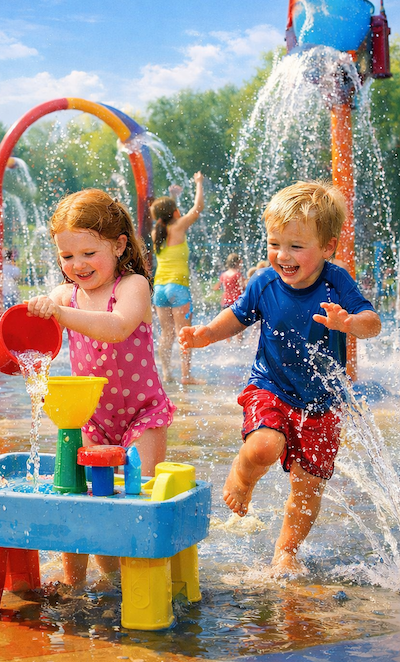
Beyond the Splash: How Water Play Builds Motor Skills in Young Children
When you take your kids to a splash pad, the goal is usually simple: cool off, burn some energy, and head home happy. But while you're watching them dart through the sprinklers and shriek at the dumping bucket, something more deliberate is happening underneath all that fun. Water play — whether at a splash pad, spray park, or aquatic center — is one of the richest physical development environments available to young children. The combination of unpredictable water, uneven surfaces, sensory feedback, and social play creates conditions that quietly build a wide range of motor skills that kids need as they grow. Here's what's actually happening developmentally when your child runs, dodges, pours, and splashes their way through a splash pad visit. --- ## 1. Running and Jumping Through Sprinklers: Balance, Speed, and Spatial Judgment Watch a toddler approach a splash pad for the first time. They slow down at the edge, test the wet ground with one foot, recalibrate, and then commit. That moment of assessment — followed by the full-speed sprint through the spray — is a genuine motor learning event. Running and jumping through water features requires children to constantly adapt to changing conditions: wet surfaces with different traction than dry ground, water streams coming from unpredictable angles, and other children moving through the same space. Unlike a flat, dry playground, a splash pad offers genuinely variable terrain. A scoping review published in the International Journal of Environmental Research and Public Health found that open, spread-out play environments that encourage active movement between features — rather than fixed equipment — are particularly effective at developing locomotor skills including running, jumping, and balance in young children. The researchers noted that "active games without props proved more beneficial for developing locomotor skills" than time spent on static equipment — a description that fits splash pad play well. (PMC10718446) At a splash pad, children naturally create those active games: racing through the sprinklers, jumping over water streams, timing their run to avoid the dumping bucket. None of it feels like exercise. All of it is building the spatial judgment and locomotor control that underpins later physical competence. --- ## 2. Dodging Sprayers and Timing Games: Reaction Time and Coordination Many splash pads have timed or intermittent features — sprayers that activate on a cycle, jets that pulse on and off, or sensor-triggered streams that respond to movement. Kids learn these patterns quickly and start playing with them: standing just outside the spray zone, timing a dash through, or challenging each other to see who can make it without getting hit. This kind of play is a natural training ground for reaction time and whole-body coordination. Reacting to a suddenly activated sprayer requires the visual system, the brain, and the body to communicate quickly — the same neural pathway that supports athletic coordination, catching a ball, and navigating a busy playground. The Vivvi Early Education research team notes that water play specifically supports the development of timing and anticipation — children learn to read environmental cues and adjust their movement accordingly, building the reactive coordination that structured sports and physical activity build later. (vivvi.com) What looks like a child playing a silly game with a sprinkler is actually repeated, self-motivated practice of one of the most important physical skills in early childhood. --- ## 3. Pouring, Squeezing, and Scooping: Fine Motor Skills and Hand Strength Not every child at a splash pad is sprinting through the jets. Many — especially toddlers — gravitate toward water tables, shallow channels, and collection pools where water gathers. Here they pour, squeeze, scoop, and transfer water from container to container for extended periods of time. This quieter form of water play is doing important work for fine motor development. Squeezing a soft water toy builds hand strength and grip. Pouring from one container to another without spilling requires wrist control and bilateral coordination — using both hands together in a coordinated way. Scooping with a small cup requires precise finger positioning and controlled movement. The National Association for the Education of Young Children (NAEYC) identifies sand and water play as among the most valuable activities for building fine motor skills in early childhood, noting that the sensory properties of water — its weight, flow, and resistance — create natural opportunities for children to develop hand strength and coordination that transfer directly to writing, drawing, and self-care tasks. (naeyc.org) If you have a toddler who seems less interested in the big sprayers and more interested in the water pooling near the drain, let them stay there. They're doing exactly the right thing. --- ## 4. Shallow Water Splash Play: Building Leg Strength and Swim Readiness Aquatic centers and splash pads with shallow wading areas offer something unique: the physical properties of water itself — buoyancy and resistance — as a movement medium. When children kick, stomp, and walk through shallow water, they're working against resistance that isn't present on dry land, building leg strength and coordination in a low-impact environment. Research on aquatic-based movement has demonstrated that water environments allow children to practice locomotor patterns — walking, running, jumping — with different muscle engagement than land-based movement, and that confidence and motor patterns developed in water can transfer to dry-land activities. A study published in BioMed Research International found that children who participated in aquatic movement programs showed measurable improvements in gross motor function, with gains in movements they had previously avoided entirely. (PMC6244299) For typically developing children, shallow water play serves as an informal introduction to aquatic movement — building comfort, body awareness, and basic coordination in water that supports later swim instruction. Children who have spent time playing in shallow water tend to enter swim lessons with more confidence and body awareness than those who haven't. --- ## What Parents Can Do to Encourage Developmental Play You don't need to turn a splash pad visit into a lesson. The most developmentally valuable thing you can do is give children time, space, and freedom to explore at their own pace. A few practical approaches: Let them lead. If your child wants to stand at the edge of the sprinklers for ten minutes before going in, let them. That observation period — reading the water patterns, watching other kids, building courage — is genuine cognitive and motor preparation. Bring a few simple tools for the little ones. A small cup, a squeeze toy, or a funnel gives toddlers something to interact with at ground level and naturally extends the fine motor benefits of water table play. Don't rush the water table. If your toddler finds a shallow collection area and starts pouring water for 20 minutes, resist the urge to redirect them to the "more exciting" features. They're engaged in exactly the kind of focused, repetitive practice that builds fine motor skills. Come back regularly. Motor skill development through play is cumulative. A child who visits a splash pad a dozen times over a summer is getting significantly more developmental benefit than one who goes twice. Frequency matters more than duration on any single visit. --- ## The Simplest Developmental Investment You Can Make Splash pads are free or low-cost, widely available, and require no equipment, instruction, or structured program. Yet they deliver a genuinely rich set of physical development benefits — locomotor skills, coordination, fine motor development, and aquatic confidence — that overlap with what structured programs try to achieve at considerably greater cost and effort. The research supports what parents intuitively sense: unstructured outdoor water play isn't a break from development. It is development. Find toddler-friendly splash pads near you → --- The research referenced in this article is provided for informational purposes only and is not intended as medical or therapeutic advice. If you have concerns about your child's motor development, consult your pediatrician or a qualified occupational therapist.