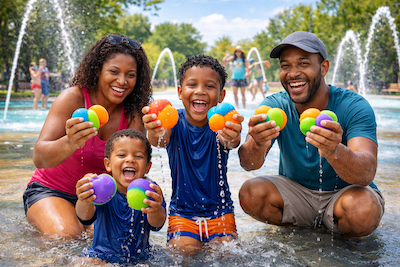
Best Splash Pad Toys for Kids: What to Bring (and What to Leave Home)
Most splash pads are designed to be self-entertaining — the jets, sprayers, and dumping buckets provide the fun. But if you've ever watched a toddler spend 40 minutes pouring water from one cup to another while completely ignoring the $200,000 spray feature three feet away, you know that sometimes the simplest toys are the ones that extend a visit from "we just got here" to "it's been two hours and they still won't leave."
The right splash pad toys don't need to be fancy. They need to interact with water in a way that's interesting, be easy to carry, and not cause problems with other families sharing the space.
Here's what works, what doesn't, and what to leave in the car.
Best Toys for Toddlers (Ages 1-3)
Toddlers at splash pads are less interested in the big spray features and more interested in what they can hold, pour, scoop, and fill. These toys support that instinct.
Stacking Cups / Nesting Cups
Why they work: Toddlers will fill, pour, stack, and dump these for an absurdly long time. They're the single most effective splash pad toy for this age group. The ones with holes in the bottom are even better — watching water drain through the holes is endlessly fascinating at 18 months.
What to look for: BPA-free plastic, bright colors, 5-8 cups that nest for easy transport. Skip the ones with complex mechanisms — simple cups with drainage holes are best.
Soft Squeeze Toys
Why they work: Rubber squeeze toys (animals, balls, letters) can be filled with water and squeezed to make a stream. The cause-and-effect of squeeze-and-spray is exactly the kind of repetitive play that toddlers thrive on. Plus they float in puddles.
What to look for: Soft silicone or rubber, easy to grip with wet hands, no small parts. Mold-resistant designs with large openings dry faster and stay cleaner between visits.
Small Watering Cans
Why they work: A toddler with a small watering can at a splash pad is a toddler who is fully engaged. They'll fill it from the spray features, pour it on the ground, pour it on their feet, pour it on your feet, and repeat. It bridges the gap between the splash pad's built-in features and self-directed play.
What to look for: Lightweight (under 1 lb when full), small capacity (16-24 oz), easy-grip handle. Metal ones get hot in the sun — stick to plastic.
Foam Letters and Numbers
Why they work: Foam bath letters stick to wet surfaces. Toddlers can press them onto the splash pad surface, and older toddlers (2-3) will start arranging letters and learning while they play. They float in puddles and are nearly indestructible.
What to look for: EVA foam (the same material as bath letters), bright colors, large enough not to be a choking hazard. Bring a mesh bag to carry them.
Best Toys for Preschoolers (Ages 3-5)
Preschoolers are ready for more interactive water play. They want to aim, build, race, and create. These toys channel that energy.
Water Wheels and Funnels
Why they work: Pour water into the top, and watch it spin wheels, turn gears, and flow through channels on the way down. Water wheels give preschoolers a sense of cause-and-effect and keep them engaged at a single station for extended periods.
What to look for: Suction-cup bases that stick to wet surfaces, multiple pouring points, durable ABS plastic. The ones designed for bath use work equally well at splash pads.
Splash Balls (Reusable Water Balloons)
Why they work: These sponge or silicone balls absorb water and can be thrown, squeezed, or dunked. They provide the fun of water balloons without the environmental mess. Kids soak them under a spray feature and throw them at each other (or at you).
What to look for: Reusable silicone or sponge construction, bright colors (easier to find when they roll away), packs of 4-6 so there are enough to share. Avoid the magnetic-seal reusable balloons — the magnets can separate.
Small Buckets with Shovels
Why they work: Even without sand, a bucket at a splash pad gives kids a mission: fill it up. They'll carry water from feature to feature, dump it, and start over. Add a small shovel or scoop and they'll channel water between puddles.
What to look for: Sturdy but lightweight, comfortable handle, 1-2 quart capacity. Sand castle sets work perfectly — you probably already own one.
Water Guns (Small Ones)
Why they work: Small water pistols and squirters are a splash pad staple for preschoolers. Fill them from the spray features, aim at each other or at a target, repeat. They add a layer of active play that the splash pad's built-in features can't provide.
What to look for: Small size (fits in a preschooler's hand), easy trigger or squeeze mechanism, low pressure. Save the Super Soakers for the backyard — at a crowded splash pad, small squirters are more appropriate. More on this below.
Best Toys for School-Age Kids (Ages 5+)
Older kids often get bored at splash pads faster than toddlers — they've figured out the features and want more complexity. These toys add a layer of challenge and creativity.
Water Blasters (Appropriate Size)
Why they work: A mid-size water blaster turns a splash pad visit into an active game. Older kids will create their own rules, set up targets, and chase each other between spray features. The splash pad becomes a playing field rather than just an attraction.
A note on etiquette: Large, high-pressure water guns can hit hard and upset younger kids. Choose medium-sized blasters and teach your kids to aim at each other (consenting participants only), not at random toddlers. If the splash pad is crowded with little ones, save the blasters for another day.
Dive Sticks and Sinking Toys (for Wading Features)
Why they work: At splash pads with shallow wading pools or collection areas, dive sticks and sinking toys give kids a retrieve-and-repeat game. Toss them into the shallow water and race to grab them.
What to look for: Brightly colored (easy to spot in murky water), weighted to sink but not too heavy, sets of 4-6.
Frisbees and Splash Discs
Why they work: Soft foam frisbees and splash discs can be thrown through spray features, creating a hybrid game that combines catching with dodging water. They add a physical activity layer to what can otherwise become passive standing-in-water play.
What to look for: Soft foam or fabric (no hard plastic that could hurt someone), water-resistant material that doesn't get waterlogged.
What NOT to Bring to a Splash Pad
Sand Toys with Sand Still in Them
Sand and splash pad drains are enemies. Sand clogs the filtration systems that keep splash pad water clean. If you bring beach toys, make sure they're rinsed clean of sand before the visit.
Large Super Soakers
High-powered water guns with pressurized streams hit hard and travel far. At a splash pad shared with toddlers and babies, a Super Soaker stream to the face of a 2-year-old is going to ruin someone's day and probably start a confrontation. Small squirters are fine. Artillery is not.
Inflatable Pool Toys
Pool floats, inflatable rings, and water wings are designed for pools with standing water. Splash pads don't have standing water, so these toys serve no purpose and take up space in common areas.
Electronics (Obviously, but Still)
Waterproof speakers, tablets in "waterproof" cases, and underwater cameras all seem like good ideas until they're not. Leave the electronics under your shade tent. The kids don't need them, and neither do the other families at the splash pad.
Glass Containers
Some families bring glass water bottles or glass food containers. Splash pad surfaces are hard — concrete, rubber, or tile. One drop and you have broken glass in a barefoot zone. Bring plastic or stainless steel only.
How to Pack Splash Pad Toys
The key to bringing toys to a splash pad is making them easy to carry and easy to clean up.
Use a mesh bag. A large mesh laundry bag or mesh beach tote holds all the toys, drains water on the walk back to the car, and dries quickly. Solid bags trap water and breed mildew.
Bring fewer toys than you think. Three or four well-chosen toys are better than a bag of ten. Kids at a splash pad have the splash pad itself as the primary entertainment — toys are supplements, not the main event.
Label everything. Splash pad toys migrate. Other kids pick them up, they float to the other side of the pad, or they get left behind. A piece of colored tape or a Sharpie initial on each toy makes retrieval easier and prevents accidental claims.
Rinse and dry after every visit. Splash pad water is treated but not sterile. Rinse toys with clean water when you get home and let them air dry completely before storing. This prevents mold and extends the life of foam and rubber toys.
The Best Toy Is Already at the Splash Pad
Here's the honest truth: the splash pad itself is the toy. The jets, sprayers, bubblers, and dumping buckets were designed by engineers to be interactive, safe, and engaging. Most kids — especially on their first few visits — don't need anything extra.
Toys become more valuable on repeat visits when the novelty of the features has faded, or for toddlers who prefer quiet, self-directed water play at the edges rather than running through the main spray features.
Start with one or two simple items — a cup and a squeeze toy for toddlers, a splash ball and a small squirter for older kids — and add from there based on what your child actually uses.
Quick-Pick Product Recommendations
Here are specific products that work well at splash pads, available from major retailers:
For Toddlers (Ages 1-3)
- Munchkin Caterpillar Spillers Stacking Cups — The classic nesting cups with drainage holes. Cheap, durable, and endlessly entertaining at a splash pad. View on Amazon
- Green Toys Watering Can — Made from 100% recycled plastic, BPA-free, and sized perfectly for toddler hands. Lightweight enough for an 18-month-old to carry when full. View on Amazon
- Munchkin Ocean Squirts Bath Toys (8-pack) — Soft squeeze toys that fill with water and squirt. Sized for little hands, each ocean animal floats and squirts. Work just as well at a splash pad as in the tub. View on Amazon
For Preschoolers (Ages 3-5)
- Melissa & Doug Seaside Sidekicks Sand & Water Sifting Funnel — A multi-level funnel and water wheel toy that gives preschoolers a pour-and-watch station. Suction cup base sticks to wet surfaces. View on Amazon
- SOPPYCID Reusable Water Splash Balls (6-pack) — Soft silicone balls that absorb water and can be thrown without hurting anyone. Self-sealing, latex-free, and come with a mesh bag. A better alternative to water balloons — no cleanup, no waste. View on Amazon
For School-Age Kids (Ages 5+)
- BEFANS Reusable Water Splash Balls (60-pack) — Soft cotton splash balls that absorb water instantly. At 60 pieces, there are enough for group play and they're easy to share. Machine washable. View on Amazon
For Carrying Everything
- Mesh Beach Bag — Any large mesh tote works. The mesh lets water drain on the walk to the car and air-dries the toys. Search "mesh beach bag" on Amazon — most options under $15 work fine.