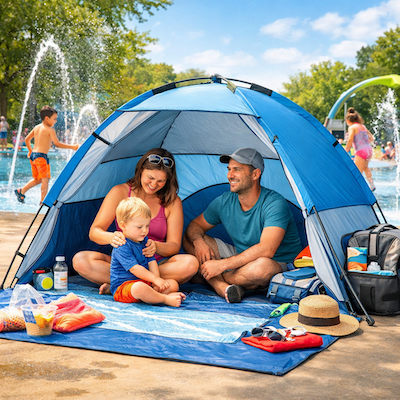
Best Portable Shade Tents for Splash Pads: Stay Cool While They Play
Here's a scene every splash pad parent knows: you arrive, the kids sprint toward the water, and you're left standing in full sun holding towels, snacks, and a diaper bag with nowhere to sit that isn't soaking wet or baking hot.
A portable shade tent solves this problem completely. It gives you a home base — somewhere dry to stash gear, a shaded spot to apply sunscreen, and a cool retreat when toddlers need a break from the water and the sun.
But not every shade tent works well at a splash pad. The ground is wet, the wind picks up across open park spaces, and you need something that sets up fast because you're doing it one-handed while a two-year-old pulls toward the sprinklers.
Here's what to look for and the best options for splash pad families in 2026.
What to Look for in a Splash Pad Shade Tent
UV Protection (UPF 50+)
This is non-negotiable. You're sitting in direct sun for hours. Look for tents rated UPF 50+, which blocks 98% of UV rays. Many budget tents advertise "shade" but offer minimal UV protection — check the UPF rating specifically.
Water-Resistant Floor
Splash pads mean wet ground. A tent with a built-in floor or waterproof base keeps your bags, towels, and snacks dry. Tents without a floor work fine if you bring a waterproof blanket or mat, but a built-in floor is more convenient.
Wind Stability
Splash pads are usually in open park spaces with no windbreaks. Your tent needs to handle gusts without becoming a kite. Look for:
- Sandbag pockets or stake loops
- A low profile that doesn't catch wind
- Fiberglass or flexible poles that flex rather than snap
Easy Setup (Under 2 Minutes)
Pop-up designs that spring open are ideal for splash pad use. You don't want to spend 15 minutes assembling poles while your kids are unsupervised near water. The best options go from bag to shade in 60 seconds.
Size
For most families, a tent that fits 2-3 adults seated is the sweet spot. Too small and it's just a gear shed. Too large and it's hard to carry and blocks other families' space. A footprint around 6x6 feet to 8x6 feet works well.
Portability
You're carrying this from the car along with everything else. Under 10 pounds with a shoulder strap or backpack carry is ideal. If it doesn't fit easily in one hand, you'll stop bringing it.
Types of Shade Shelters That Work at Splash Pads
Pop-Up Beach Tents
Best for: Families with toddlers who need a contained shaded space
These spring-open tents are the easiest to set up — literally unfold and they're done. Most include a floor, three walls, and an open front. They're lightweight (3-5 lbs), compact, and designed for exactly this use case.
Pros: Instant setup, lightweight, built-in floor, affordable ($25-60)
Cons: Limited headroom, less wind-stable than canopies, smaller coverage area
Pop-Up Canopies (10x10 or smaller)
Best for: Families who want maximum shade coverage and plan to stay for hours
These are the square canopy tents with four legs that you see at farmers markets and sports events. They provide the most shade area and headroom, and many now come in compact, one-person-setup designs.
Pros: Large shade area, tall enough to stand under, excellent airflow
Cons: Heavier (15-25 lbs), more setup time, no floor, can catch wind if not anchored
Shade Sails and Tarps
Best for: Experienced outdoor families who want ultralight portability
A shade sail or tarp strung between poles or trees provides excellent coverage with minimal weight. Some modern designs use trekking poles or dedicated lightweight poles.
Pros: Ultralight (1-3 lbs), packable, maximum airflow
Cons: Requires trees or poles, more setup skill, no floor or walls, less wind protection
Umbrella-Style Sun Shelters
Best for: Solo parents or minimal-gear trips
Large beach umbrellas or clamp-on stroller umbrellas provide quick, no-setup shade for one or two people. Not as comprehensive as a tent, but better than nothing and trivially easy to carry.
Pros: Zero setup, ultralight, inexpensive
Cons: Limited coverage, no floor, easily blown over without a good anchor
Our Top Picks for Splash Pad Shade
Best Pop-Up Beach Tent: Pacific Breeze Easy Setup Beach Tent Deluxe XL
SPF 50+ protection, fits 4 people, and sets up in seconds. The extendable floor keeps your gear off wet ground — exactly what you need at a splash pad. One of the most popular and well-reviewed beach tents on Amazon.
View on Amazon
Best Lightweight Shade: Neso Portable Beach Tent
At just 4 lbs, the Neso is the easiest shade to carry. UPF 50+ rated (tested at UPF 185-500), and the sand anchor design keeps it stable in winds up to 20 MPH. The 7x7 ft footprint provides solid coverage without taking up too much space. Great for the parent who wants shade without hauling a big tent.
View on Amazon
Best Budget Option: OutdoorMaster Pop Up Beach Tent (4-Person)
UPF 50+ protection with a removable skylight for ventilation, at a lower price point than the Pacific Breeze. Pops open in seconds with no assembly. A solid choice if you're trying this out for the first time and don't want to invest heavily.
View on Amazon
Best for Babies and Toddlers: Babymoov Aquani Anti-UV Tent & Pool
This one is specifically designed for families with babies — it's a UPF 50+ pop-up tent that converts into a small paddling pool. Lightweight, insect-protected, and sized for infants and toddlers. If your splash pad visits revolve around a baby under 2, this is purpose-built for you.
View on Babymoov
Best Full Canopy: Coleman Oasis Pop-Up Canopy
If you want maximum shade area and room to stand, Coleman's canopy line delivers. The DayTripper packs down smaller than a gallon of milk, while the Road Trip model handles extreme wind. These are heavier than beach tents but provide the most coverage for families who plan to stay all day.
View on Coleman
Features Worth Paying Extra For
Sand pockets / weight bags: If the tent has corner pockets you can fill with sand or rocks, it stays put in wind without stakes. Essential for splash pads where you can't always stake into concrete or rubber surfaces.
Ventilation panels: Rear mesh windows prevent the tent from becoming a greenhouse. On a 95-degree day, airflow is the difference between a cool retreat and a sauna.
Interior pockets: Small mesh pockets inside the tent keep phones, keys, and sunscreen organized and off the wet ground.
Dark interior lining: Silver or dark-coated interior linings reduce heat buildup significantly compared to thin single-layer fabric.
Splash Pad Shade Setup Tips
Arrive early to claim your spot. The best shade positions — near the splash pad but not in the spray zone — go fast on hot days. Getting there 15-20 minutes before the crowds gives you first pick.
Anchor to the ground surface. At splash pads with rubber or concrete surfaces, you can't use stakes. Bring sandbags, water jugs, or fill the tent's weight pockets with rocks from the park. A tent that blows away is worse than no tent.
Position upwind of the splash pad. This keeps spray from drifting into your shade area and keeps your dry gear actually dry.
Bring a ground mat. Even with a tent floor, a waterproof picnic blanket or foam mat adds comfort and keeps the wet splash pad surface from soaking through.
Don't block other families. Splash pads are shared spaces. Set up at the perimeter, not directly adjacent to the spray features. Leave room for other families to find shade too.
What to Bring Under Your Shade Tent
A shade tent turns a 30-minute splash pad visit into a half-day outing. Here's what to stash under it:
- Dry towels (at least one per kid plus extras)
- Sunscreen for reapplication every 90 minutes
- Water bottles — hydration matters more in heat + sun
- Snacks in sealed containers (wet hands + open chip bags = mess)
- Change of clothes for each kid
- A waterproof bag for wet swimwear on the way home
- Your phone/book — you've earned some sit-down time
The Bottom Line
A portable shade tent is the single most useful piece of gear you can bring to a splash pad after sunscreen and towels. It turns an exposed, hot experience into a comfortable outing where the adults actually enjoy themselves too.
For most splash pad families, a pop-up beach tent in the $30-50 range is the best balance of portability, UV protection, and convenience. If you visit splash pads regularly, it pays for itself in comfort by the second trip.